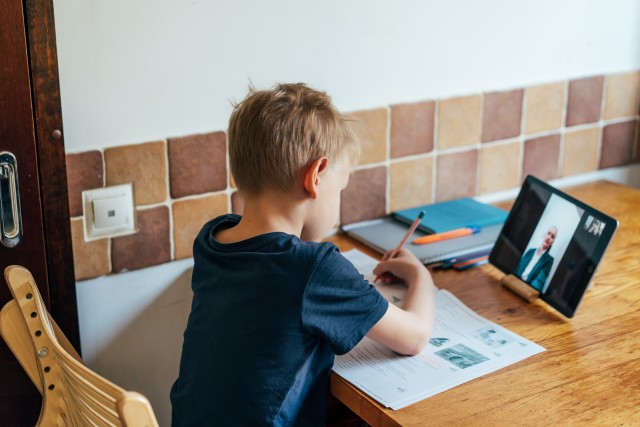
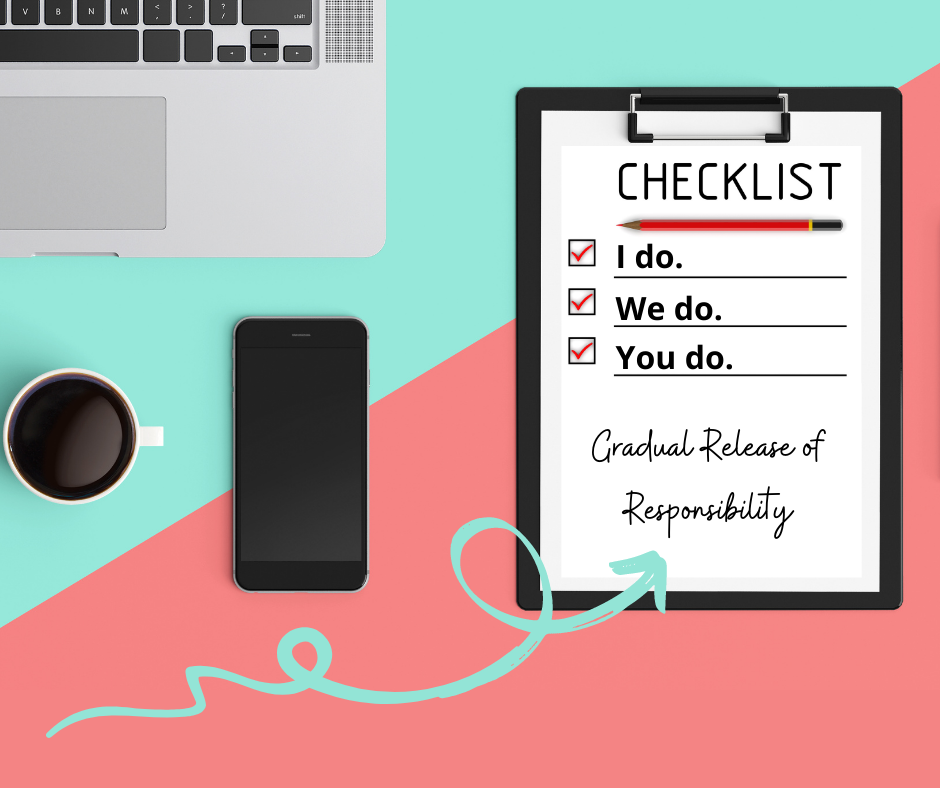
A common mantra in teaching is “I do. We do. You do.” This refers to the “gradual release of responsibility” from teachers to students, introduced by P. David Pearson and Margaret C. Gallagher in the context of teaching reading comprehension in 1983. In the model, teacher demonstration of a lesson skill is the “I do,” guided practice with students doing the skill with teacher support is the “We do,” and independent practice, or the “You do,” is students doing the skill on their own.
The gradual release model can be a very explicit way to teach and a simple enough rule to follow. One example of a teacher implementing this method during a lesson could be that the teacher shows a class how to determine the main idea after reading a passage, then the teacher has a student describe the main idea after reading a new passage in front of the class with the teacher stepping in to help as needed, and finally, students work independently to find the main idea to assigned passages in class or as homework.
In the more than 35 years since this framework was introduced in relation to reading, it has become a popular method, or model, to teach students across many subjects. In 2019, Sandra Webb, Dixie Massey, Melinda Goggans, and Kelly Flajole reviewed how the framework changed over the years for the journal, The Reading Teacher. The authors investigated the grounding research for the framework and the shift from analyzing students’ work performance to studying how students think and educators teach. Over the years, this model has evolved, including the addition of a potential fourth step of collaboration with peers, sometimes phrased as “You do it together.”
The authors explain how the release of responsibility from demonstration, guided practice, and independent practice is easy to implement in a sequential order; however, teaching is far more complicated than using a simple rule and moving on. In actuality, the release of responsibility is less about being gradual in a linear way and more about being flexible in a reflective way. Teachers must understand the needs of the students in the classroom, the context of the lesson objectives, and the task at hand. As a first step in a lesson, sometimes students don’t need a demonstration. Instead, they can explore a topic on their own (independent practice) or a teacher can guide a child through a new lesson topic together (guided practice). With formal and informal assessments, observations, and understanding the whole child, teachers can decide where to enter the release of responsibility “continuum” (Webb et al., 2019, p. 79).
This “flexible” perspective allows instruction to be creative, adaptive, and individualized for students, and can result in a much more rewarding and effective way to teach for everyone.
Subscribe
Please subscribe at the bottom of this page if you would like to receive notifications when new blog posts become available. Thank you.